
Stop Losing 6-Figure Client Deals to Dev Partners Who Can't Guarantee Delivery
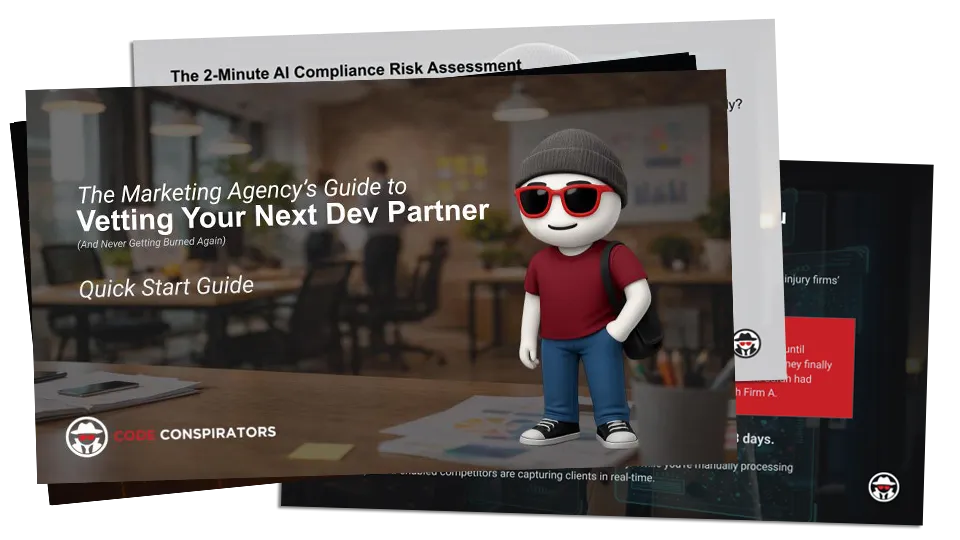
Download the free 15-page guide that shows you how to vet your next dev partner in 15 minutes, so you never get burned by missed deadlines, blown budgets, or subpar quality again.
In this 2.5-minute video, you'll learn:
✓ Why most dev partnerships fail (and cost agencies $500K-$2M+ annually)
✓ The 3 critical questions that expose unreliable dev partners in the first conversation
✓ How Rebel Fox used proper vetting to win a $690K+ campaign (case study)
✓ The Triple Lock Guarantee™ framework you can use to evaluate ANY dev partner
🔒 FROM THE CREATORS OF THE TRIPLE LOCK GUARANTEE™
The only white-label dev partner that guarantees:
✓ On-Time Delivery (or 25% comp)
✓ On-Budget Delivery (fixed price, no surprises)
✓ Zero Client Complaints (30-day free fixes)
HERE'S WHAT'S HAPPENING:
Your Agency Pitches Big, But Can't Guarantee Delivery
You're pitching 6-figure campaigns where website/dev work is the entry point.
But when the client asks: "Can you guarantee this will be done on time?"
You hesitate.
The problem? Your dev partner has burned you before.
You've had projects:
- Miss deadlines by 6+ weeks
- Blow budgets by 30-50%
- Launch with major bugs
- Require 20+ hours of your time managing issues
So you underbid to win (and lose margin), or you overbid (and lose the pitch).
Either way, you lose.
You're doing qualification AFTER you pitch instead of BEFORE.
That's backwards. And it's costing you 6-figure campaigns.
You're Treating All Dev Partners the Same
When a dev partner reaches out, your team evaluates them based on:
- Portfolio (looks nice)
- Price (seems reasonable)
- Vibe (they seem competent)
First bid, first hired.
But not all dev partners are equal.
A reliable partner who delivers on-time, on-budget, with zero client complaints is worth 10X more than a cheap freelancer who ghosts mid-project.
But you're treating them the same because you don't have a systematic way to tell the difference.
Your best campaigns are sitting in the pipeline, waiting for dev partners you can actually trust.
By the time your team vets them (after 1-2 failed projects), the campaign opportunity is gone.
You need a triage system, not a first-come-first-served system.
You need ONE vetting framework that everyone follows, every time.
Your Team Doesn't Know What "Reliable" Actually Means
Ask three people on your team: "What makes a dev partner reliable?"
You'll get three different answers:
- One person thinks "anyone with a nice portfolio"
- Another thinks "anyone who can code"
- Another thinks "anyone with decent reviews"
Without a clear definition and scoring system, reliability is subjective.
The result? Inconsistent vetting, missed red flags, and wasted time.
Junior staff might pass on a great partner because they "seemed expensive."
Senior staff might hire a disaster because "they had a nice website."
You need a standardized scorecard that turns subjective judgment into objective data.
So everyone vets the same way, every time.
Bottom line: You're vetting dev partners with guesswork, not data.
You're asking the wrong questions, looking at the wrong signals, and relying on gut feel instead of a systematic framework.
That's not your fault. Most agencies inherited this process from the "post your project on Upwork and hope for the best" era when dev work was an afterthought.
But in 2025, dev work is the ENTRY POINT to 6-figure campaigns—and you're getting 10X more partnership inquiries than you did 5 years ago.
Your old vetting process can't handle the new volume.
That's why we built the Triple Lock Guarantee Framework.
Here's what's inside:

WHAT'S INSIDE The guide
Here's What You'll Learn in the Next 15 Minutes
This isn't theory. It's a battle-tested framework used by 50+ agencies to vet dev partners and protect their margins.
INSIDE THE 15-PAGE QUICK-START GUIDE:
📋 THE 5 RED FLAGS
Spot disaster before you sign the contract.
See the 5 warning signs that signal your dev partner will blow the timeline, budget, or quality, before you waste a single dollar, or minute.
Red flags include:
✓ They can't show you a detailed estimation process (they're guessing)
✓ They won't guarantee delivery (no accountability)
✓ They don't have transparent project tracking (you'll be in the dark)
✓ They're "yes men" with no strategic pushback (order-takers, not consultants)
✓ They don't offer post-launch support (you'll pay for their mistakes)
Why this matters:
If you see 2+ red flags, walk away, or lose $50K-$200K.
🚨 THE ESTIMATION RED FLAG CHECKLIST
How to tell if they're guessing vs. using data.
The #1 reason budgets explode: dev partners GUESSED at the estimate.
Learn to spot estimation red flags:
✓ Round numbers ("about 60 hours" = guessing)
✓ No breakdown by deliverable (they don't know what it takes)
✓ Wide time ranges (40-80 hours = 100% variance = clueless)
✓ No historical data referenced ("we think" = not "we know")
✓ No contingency/buffer explained (every surprise = surprise bill)
✓ They can't explain what's NOT included (scope creep guaranteed)
Why this matters:
If the estimate is a guess, your margin will evaporate.
❓ THE 7 QUESTIONS TO ASK
Vet any dev partner in 15 minutes.
Most agencies ask surface-level questions ("How much?" "How long?"). Then they're shocked when projects blow up.
The 7 questions that expose the truth:
1. How do you estimate projects? (Data or guessing?)
2. What happens if you miss the deadline? (Guarantee or excuses?)
3. How do you handle scope changes? (Process or chaos?)
4. How will I know where the project stands? (Transparency or ghosting?)
5. What happens if my client has quality issues? (Support or surprise bills?)
6. Can you show me 3 similar projects? (Experience or learning on your dime?)
7. What's your backup plan if something goes wrong? (Resilience or fragility?)
Why this matters:
If you get 3+ red flag answers, you'll get burned.
📄 THE WHITE-LABEL CONTRACT TEMPLATE
Protect your agency legally before you sign.
Most contracts protect the DEV PARTNER—not you. Then when projects fail, you have no recourse.
The 8 clauses you MUST include:
1. Fixed-price guarantee (no surprise bills)
2. On-time delivery guarantee with penalty (accountability)
3. Quality guarantee with 30-day support (free fixes)
4. Scope change process (you approve all changes in writing)
5. Communication standards (weekly updates, response time SLA)
6. White-label confidentiality (they can't steal your clients)
7. Termination rights (you can exit if they fail)
8. Client owns all work product (no IP claims)
Why this matters:
It costs $500 for legal review. It could save you $50K-$200K.
💡 CASE STUDY: $40K WEBSITE → $650K CAMPAIGN
Real agency. Real results.
The Story:
Rebel Fox was pitching an $800K+ campaign to a major science museum. Website redesign was the entry point.
Their previous dev partner couldn't guarantee ADA compliance, putting the entire $800K at risk.
What Rebel Fox did:
- Vetted a new partner using the framework in this guide
- Asked the 7 questions
- Demanded Triple Lock Guarantee protections in the contract
The Result:
- Website delivered on-time, on-budget, 100% compliant
- Museum approved the full campaign
- 2 referrals from other institutions
- Total impact: $890K+ value from proper vetting
Why this matters: The website wasn't just $70K, it was the key to $800K. One bad dev decision would have killed the entire opportunity.
🔒 THE TRIPLE LOCK GUARANTEE™ FRAMEWORK
Evaluate ANY dev partner in 15 minutes.
Use this scorecard to rate potential partners:
- LOCK #1: Do they guarantee on-time delivery (with penalty)?
- LOCK #2: Do they guarantee on-budget delivery (fixed price)?
- LOCK #3: Do they guarantee zero client complaints (30-day free fixes)?
SCORING:
- 13-15 points = ✅ Green flag (move forward)
- 8-12 points = ⚠️ Yellow flag (proceed with caution)
- 0-7 points = ❌ Red flag (walk away)
Why this matters:
This 15-minute test could save you
$500K-$2M+ in blown projects.
REAL AGENCIES, REAL RESULTS
Agency Owners Using This System to Dominate Their Markets


Kristin L.
Principal,
PPC/SEO Agency

"We'd been burned by dev partners before, promises made, deadlines missed. Code Conspirators was different from day one. They delivered the site 3 days EARLY, under budget, and our client was thrilled. This guide shows you exactly what to look for."

Chris R.
Creative Director,
PR & Design Agency
"The website was our proof-of-concept for an $800K campaign. We couldn't pitch that without proving we could deliver the technical foundation flawlessly. This vetting framework helped us find a partner who GUARANTEED compliance, and we won the full engagement."

Kathy P.
Managing Director,
Full-Service Marketing Agency
"We've worked with a dozen dev shops over the years. This guide taught us what questions to ask that we'd been missing. Now we know how to spot the red flags BEFORE signing, not after we've lost $50K."
who this is for
This Guide Is For You If...
✅ You've been burned by unreliable dev partners (missed deadlines, blown budgets, subpar quality)
✅ You're pitching 6-figure client projects and need confident delivery to win
✅ You're tired of margin erosion from budget overruns eating your profit
✅ You can't pitch big campaigns because you can't guarantee your dev partner will deliver
✅ You're exploring white-label partnerships and don't know what questions to ask
✅ You want to scale your agency without hiring in-house devs (and the $80K-$120K+ cost)
This Guide Is NOT For You If...
❌ You're happy with your current dev partner (and they consistently deliver on-time, on-budget)
❌ You only do small projects (under $5K, this framework is overkill for tiny projects)
❌ You have a full in-house dev team (you don't need to vet external partners)
Download Your Free Quick-Start Guide Now.
Discover exactly where you're losing qualified clients, and how to fix it,
without hiring more sales staff or buying expensive software.
COMMON Questions
Every minute you wait gives your competitors more advantage.
Let’s fix that now.
Is this really free?
Yep. No credit card required. No hidden fees. Just enter your name and email, and you'll get instant access to the Quick-Start Guide.
Will you spam me after I download?
No, promise. You'll get the guide immediately, plus a follow-up email sequence with additional resources (7 emails over 14 days). You can unsubscribe anytime. We'll never sell your info or spam you.
Is this just a sales pitch disguised as a guide?
No. The Quick-Start Guide is 15 pages of pure frameworks, checklists, and tools. There's one mention of Code Conspirators at the end (with a soft CTA to schedule a demo if you want). 95% is actionable content you can use immediately, even if you never talk to us.
What if I already have a dev partner?
Perfect. Use the Triple Lock Scorecard to rate your current partner.
- 13-15 points? You're good. Keep them.
- 8-12 points? Yellow flag. Negotiate improvements or start vetting backups.
- 0-7 points? Red flag. Start looking for a replacement.
The guide also includes a 30-day transition plan if you need to switch mid-project (not in Quick-Start, but mentioned for Full Playbook upgrade).
Do I need the Full 100-Page Playbook, or is the Quick-Start enough?
Depends on your situation:
Quick-Start Guide is enough if:
- You just need to vet one dev partner quickly
- You want the core framework (5 red flags, 7 questions, scoring system)
- You're comfortable implementing without templates
Full Playbook is better if:
- You're building multiple white-label partnerships
- You want complete contract templates (ready to use)
- You need platform-specific vetting guides (WordPress, HubSpot, Salesforce, etc.)
- You want 50+ case studies across industries
Think of Quick-Start as "get started in 15 minutes" and Full Playbook as "never get burned again (complete system)."
Who created this guide?
Code Conspirators, a white-label dev team that's partnered with 50+ marketing agencies over 10+ years. We've delivered 500+ projects with 98% on-time delivery and 97% on-budget delivery.
We built this guide because we kept seeing agencies get burned by unreliable dev partners, and we wanted to give them the framework to vet us (and everyone else) properly.
How long does it take to read?
15-20 minutes if you read straight through. Most people skim to the sections most relevant to their situation (vetting a new partner, signing a contract, etc.) and spend 5-10 minutes.
What makes this different from other dev partner guides?
Three things:
1. It's battle-tested. This framework has been used by 50+ marketing agencies to vet dev partners. It's not theory, it's proven.
2. It's specific. Not generic "look for good communication" advice. You get word-for-word questions to ask, a scoring system (0-15 points), and red/green flag answers.
3. It's ready to use. You can vet a dev partner TODAY using the Triple Lock Scorecard. No "implement our advice over 6 months" fluff.
Is this for small agencies or large agencies?
Both. The framework works for:
- Small agencies (5-10 people): You're building your first white-label partnerships
- Mid-size agencies (11-25 people): You're scaling and need reliable partners
- Large agencies (26-50+ people): You're managing multiple dev relationships
If you're outsourcing dev work, this applies to you.
What if I have questions after reading the guide?
Just reply to any of the follow-up emails and ask. Or schedule a free 15-minute call. We're happy to help, no sales pitch required.
Can I share this with my team?
Absolutely. Forward the PDF to anyone on your team who vets dev partners. The more people using the same framework, the more consistent your results.
What if I need help RIGHT NOW (mid-project emergency)?
We specialize in emergency project rescues. The Quick-Start Guide has a section on "What to do if your dev partner ghosts you", but if you need hands-on help, reach out immediately.
800.698.5859, or
[email protected]
STAY UP TO DATE
get our covert Intel, straight to your inbox